
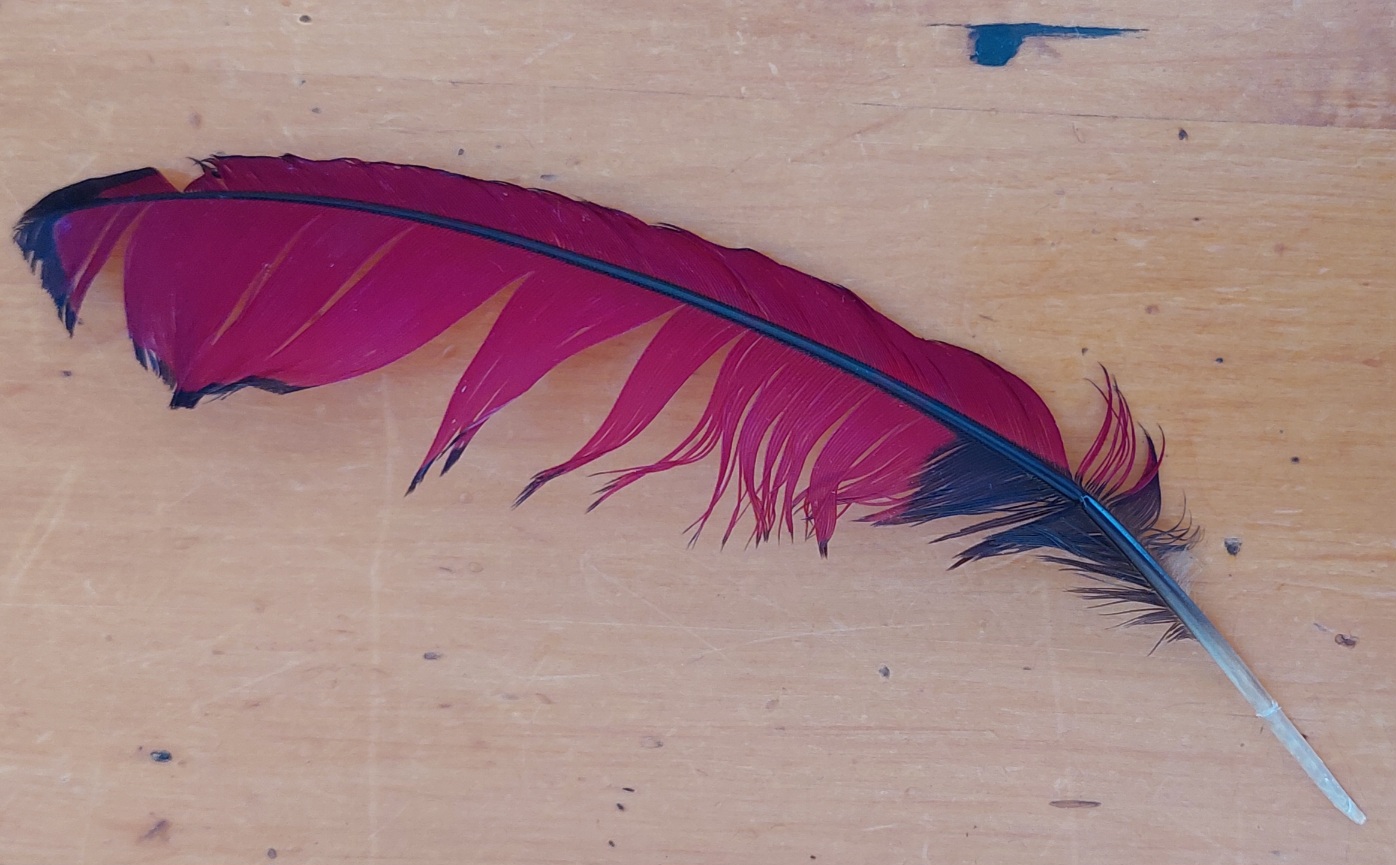
 My family was walking through the unique and beautiful Knysna forest while holidaying at the southern region of South Africa. As we walked, my son picked up this special red feather. It was dropped by a Knysna Loerie, a big green beauty of a bird, endemic to this little region. The loerie shows off a few bright red feathers on its underside when it takes off to fly. We hadn’t found just…any of the loerie feathers. It was a red one.
So, we took the feather with us back home.
But at home in the bowl on the kitchen table, it honestly kind of looked really un-special. It reminded me of the fake, toy red feather that my kids got with their dress-up hat. Because we have little interest in birds, my wife told me to please get rid of it.
Before throwing it in the bin, I wondered if there was any use for it. My mind jumped to our bird-watcher friend, and his friend who takes high-paying clients on bird-watching tours for a living. If I gave our friend the feather, he could bring it with him on a client tour. Once a client had finally spotted the special loerie bird for the first time on the tour, our friend could hand a client the actual red feather. This client would more than likely place a far higher value on the feather. The feather’s value would go from junk status to precious memento at the moment it changed hands. Its value would skyrocket.
This got me thinking about a key principle of the REWX: “Equivalent Wealth”: Money invested in the REWX greatly increases in value the moment it changes hands. The next paragraph explains why.
A certain family can spend up to $50 on a family meal at a restaurant. But if they then give $50 to a poor family, the value of the same amount of money changes greatly. The poor family might be enabled to buy many more meals, even food for a whole month. Like with the red feather, the real value of $50 increases the moment it changes hands. Also like with the red feather, the reason is because the family that receives the money has a different situation to the family that gave it. It’s almost as if giving the money to the poor family multiplies its value from 1 meal to 30 meals or more. Giving the money multiplied the real value over 30 times!
(Please note: this multiplication DOES depend on how the $50 is used. Multiplication only works if the poor family uses the money for good. If they use it for something bad like an addictive substance, the value of the money is then of course wasted).
Let’s go back to the REWX principle of Equivalent Wealth. The principle is explained as follows: When higher-income person gives to a lower-income person, the equivalent value of the money is multiplied, because the money goes further for them.
The REWX provides an opportunity to give the poor family member real value that multiplies because it has more value to the poor person. And, the REWX goes further: it enables us to ensure the poor family member not only uses the money for good, but uses it for the best kind of good. They get employed in a job. A job is what most unemployed poor people value most. The REWX also formally records and shows the giver how much their money multiplied.
May the multiplication begin!
1 Comment. Leave new
This is exactly what South Africa is crying out for! We are constantly bombarded with what’s wrong with the system and why the system doesn’t work, it’s great to see practical out of the box solutions presented in this format.